Order ai prosthetic hand now
Human motion
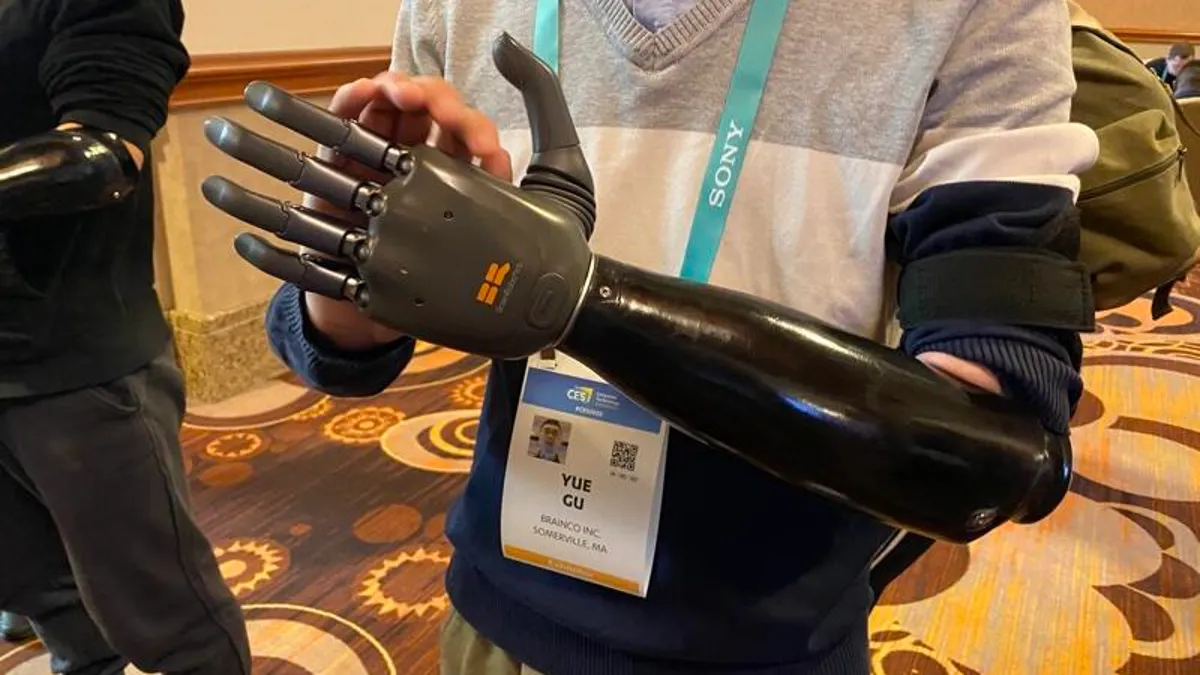
Atom Limbs uses advanced sensors and machine learning – where computers train themselves to become more accurate – to interpret electrical signals from a person’s brain and use them to move and manipulate a prosthetic limb.
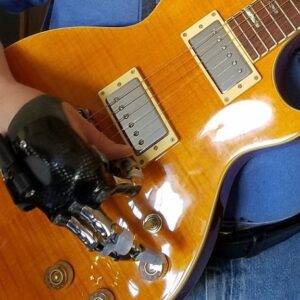
The arm has a full range of human motion in the elbow, wrist, and individual fingers – and it provides haptic feedback to the wearer on their grip strength.
The arm attaches via a strengthened sportswear-style vest which distributes the weight of the arm evenly. Although it still has some weight to it, it is considerably lighter than other bionic arms I’ve seen.
It’s non-invasive, meaning it doesn’t need any surgery or implants to function. It connects to the wearer’s residual limb firstly with bands of sensors that measure electrical signals, and then via a cup that fits over the top, with the arm connecting via an interface.
Despite avoiding upper-arm prosthetics before, when Atom Limbs said I could have a try at operating a digital version of the arm on a computer screen, via their control software, I was interested enough to say yes.
I do have residual muscles in my arm that I was able to “assign” to corresponding hand, wrist and elbow movements, which proved to be a unique, mind-boggling experience.
The notion of learning how to control a part of the body I don’t have is almost impossible to describe.
Out of reach
However, exciting though this technology is, one issue that is always of concern to disabled people when new products come into being is cost.
The assistive devices landscape is littered with products that, while impressive, can cost many times an average yearly salary. That puts most devices out of reach for many disabled people who statistics show are more likely to be among the poorest in society.
Atom Limbs says it hopes its arm will be positioned around the $20,000 (£15,000) price point, which – while still a hefty sum of money – is considerably less than many other bionic products on the market.
Ian Adam, a lecturer in prosthetics and orthotics at the University of Derby, says while this may sound like a lot, it is a good price in the industry – though it won’t be for everyone.
“It’s at the cheaper end of the market, but say you had an accident and got a pay-out, well that’s got to last the rest of your life,” he said.
“So I think a lot of patients are canny about what they spend their money on… sometimes people are quite prepared to not use them at all – with upper limb prosthetics it can be just an extra thing that not everybody will decide they need to have.”
Be the first to review “ai prosthetic hand”
Related products

Reviews
There are no reviews yet.